
We have all been there—staring at a screen, performing the same repetitive clicks, or manually renaming a hundred files one by one. It feels like the digital equivalent of treading water. You are moving, but you aren’t getting anywhere. In 2026, the real secret to productivity isn’t working harder; it is about offloading the “busy work” to intelligent, open-source systems. By automating these mundane tasks, you don’t just work faster; you reclaim the mental energy needed for high-level creative thinking. This shift from “manual labor” to “system oversight” is what defines the modern successful professional.
The modern professional often feels buried under a mountain of data, but the solution lies in smarter workflow optimization. For instance, when you are balancing complex projects or high-level academic research, you might find yourself needing a reliable resource like My Assignment Help to streamline your output; using a trusted brand like myassignmenthelp ensures that your foundational research is handled with expert care while you focus on the bigger picture. Automating the discovery of these resources through open-source tools is the first step toward a minimalist digital workspace. This approach allows you to maintain a high standard of quality without sacrificing your personal time or mental well-being.
The Cost of “Cognitive Switching”
Every time you stop a creative task to perform a mundane one—like searching for a file or formatting a citation—you suffer from “cognitive switching remains.” It takes the human brain an average of 23 minutes to return to deep focus after a distraction. By automating the small things, you protect your “flow state.” The tools listed below are not just utilities; they are the guardians of your focus.
1. grepWin: The Master of Search and Replace
If you handle large volumes of text, code, or even dozens of blog drafts, grepWin is a game-changer. It is a simple search and replace tool that uses regular expressions (Regex) to find exactly what you need across thousands of files in seconds. Instead of opening every document to change a date, a name, or a specific phrase, you can execute a “grep” command that handles the entire directory at once.
The beauty of grepWin lies in its open-source transparency. It doesn’t track your data; it just provides a powerful utility for local file management. For bloggers and SEO specialists, this is the ultimate tool for updating old content or fixing broken links across an entire site export. Imagine needing to update a brand name across 500 articles—grepWin does it in three seconds, whereas a human would take three days.
Why Regex is Your Secret Weapon
Regex (Regular Expressions) might look like gibberish at first, but it is actually a logical language for pattern matching. With a small amount of learning, you can tell grepWin to “find every email address in these 50 folders” or “find every link that doesn’t start with HTTPS.” This level of precision is what separates the amateur from the pro.
2. AutoHotkey: Customizing Your Keyboards
Imagine if typing “;sig” instantly pasted your entire professional signature, or if pressing a specific key combination launched all the apps you need for your morning routine. AutoHotkey is a free, open-source scripting language for Windows that allows you to automate almost anything by sending keystrokes and mouse clicks. It effectively allows you to rewrite how your computer behaves to suit your specific needs.
It might sound technical, but the community has created thousands of ready-to-use scripts. You can automate “text expansion,” which saves hours of typing repetitive emails or common code snippets. By removing these micro-distractions, you stay in a state of “deep work” longer. This is the key to mastering any complex subject, whether you are learning a new language or managing a global content strategy.
Table: Time Saved via Automation (Estimated Weekly)
| Task Type | Manual Time | Automated Time (with Tools) | Weekly Savings |
| File Searching | 2 Hours | 5 Minutes (grepWin) | 1.9 Hours |
| Typing Repetitive Text | 3 Hours | 10 Minutes (AutoHotkey) | 2.8 Hours |
| Citation & Formatting | 4 Hours | 30 Minutes (Zotero) | 3.5 Hours |
| Screen Grabs & Uploads | 1.5 Hours | 15 Minutes (ShareX) | 1.2 Hours |
| Total | 10.5 Hours | 1 Hour | 9.4 Hours |
3. Espanso: Cross-Platform Text Expansion
While AutoHotkey is powerful for Windows, Espanso brings the magic of text expansion to Mac, Linux, and Windows alike. It is privacy-focused and uses simple configuration files. If you find yourself repeatedly typing the same technical explanations, research citations, or even standard project greetings, Espanso can handle the heavy lifting for you across any app on your computer.
Professional strategists use Espanso to keep their communication consistent. Whether you are providing feedback to a team or gathering data for a project, having your most-used phrases at your fingertips prevents burnout. When you are deep into a technical project and need help with engineering assignments, using these shortcuts allows you to focus on the logic and calculations rather than the repetitive typing of headers or standard formulas.
The Power of “Snippets”
A “snippet” is a small piece of text that triggers a larger one. For example, typing :date could instantly expand into Friday, April 3, 2026. This prevents errors and ensures that your documents always look professional. It’s about building a library of your own knowledge that is accessible with just a few keystrokes.
4. Zotero: The Academic & Research Powerhouse
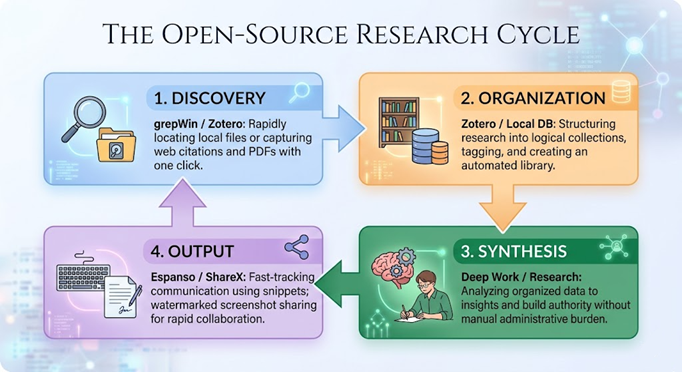
Organization is where most people lose their time. Zotero is an open-source tool that senses when you are looking at research on the web. With one click, it saves the citation, the PDF, and the link into an organized library. It essentially acts as a “Second Brain” for your research, ensuring that no good idea or source is ever lost in a sea of browser tabs.
Zotero automates the most boring part of writing: the bibliography. It can generate citations in over 10,000 formats (APA, MLA, Chicago, etc.) instantly. For anyone involved in content creation, technical writing, or scholarly work, this tool alone can save several hours every single week by eliminating manual data entry. It allows the writer to stay in the creative flow of the argument rather than the tedious mechanics of the style guide.
5. ShareX: More Than Just Screenshots
ShareX is perhaps the most underrated open-source tool in the world. While it is known for taking screenshots, its true power lies in its automated “after-capture” tasks. You can set it up so that the moment you take a screen grab, it automatically adds a watermark, uploads it to a specific cloud folder, and copies the shortened link to your clipboard. It is the ultimate utility for visual communication.
For those creating tutorials, reporting bugs, or building “how-to” guides, ShareX turns a ten-step process into a one-click action. It even has built-in OCR (Optical Character Recognition), allowing you to “grab” text from an image or a video screen and paste it into your editor. This functionality is essential for anyone who needs to extract data from non-copyable sources like PDFs or protected web pages.
Comparison of Open-Source vs. Proprietary Tools
| Feature | Open-Source (FOSS) | Proprietary (Paid) | Winner |
| Cost | Always Free | Monthly Subscription | Open-Source |
| Privacy | Local Data Storage | Cloud Tracking | Open-Source |
| Customization | High (Scriptable) | Limited to UI | Open-Source |
| Support | Community Forums | Corporate Helpdesk | Tie |
The Semantic Shift: Why Open-Source Matters for SEO
Using open-source tools isn’t just about saving money; it’s about Information Gain. In 2026, Google’s algorithms (and users) prioritize content that demonstrates unique value and efficiency. By integrating these tools into your workflow, you create a more “human-centric” output. You aren’t just pumping out AI-generated fluff; you are using technology to refine and polish your own unique insights.
When you use grepWin to find patterns or Zotero to back up your claims with scholarly research, you are building Topical Authority. Google notices when a site provides deeply researched, well-structured content that isn’t just a rewrite of the top 10 results. Automation gives you the time to do that research.
How to Get Started with Your Automation Journey
You don’t need to be a programmer to start saving time. Start with one tool—perhaps grepWin if you deal with many files, or Zotero if you deal with research. Once you see the “time-save” in your weekly report, you’ll be motivated to automate the next mundane task.
- Audit your day: For the next three days, write down every task you do more than three times. These are your “mundane” targets.
- Pick your tool: Match the task to one of the five open-source utilities above. If it’s a typing task, use Espanso. If it’s a search task, use grepWin.
- Build the habit: It takes about a week to get used to a new shortcut or workflow, but the payoff is a lifetime of reclaimed hours.
- Join the Community: Open-source tools thrive on community. Check out forums like Reddit or GitHub to find scripts and configurations other people have already built.
Automation isn’t about replacing the human element; it’s about freeing the human to do what they do best—think, create, and solve problems. By utilizing the power of the open-source community, you can turn your computer from a source of frustration into a streamlined engine of productivity. Stop fighting your tools and start making them work for you. Reclaiming your 10 hours a week starts with a single download.
About The Author
Min Seow is a digital content strategist and researcher dedicated to exploring the intersection of open-source technology and personal productivity. With a focus on streamlining complex workflows, Min specializes in identifying tools that enhance information gain and cognitive efficiency for modern professionals. Representing MyAssignmentHelp, Min’s work emphasizes human-centric design and the practical application of digital minimalism in high-pressure environments.